
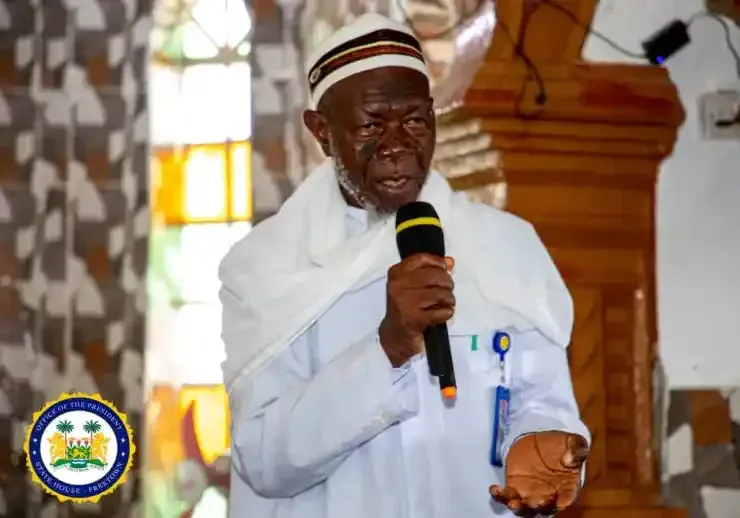
Religious leaders are ultra-powerful stakeholders in Sierra Leone society
An opinion piece drawing on IfD's research finds religious leaders more supportive of birth spacing than commonly assumed and reveals exactly where their objections to modern contraceptives actually come from.
Almost one in ten women in Sierra Leone who choose not to use a modern contraceptive, one that could protect them from an unwanted pregnancy, do so for religious reasons. Religious belief runs deep among women and men in Sierra Leone, and religious leaders play an outsized role in shaping it.
A 2021 study commissioned by the Christian Health Association of Sierra Leone (CHASL) found that Christian religious leaders were generally against the use of modern contraceptives, while Muslim religious leaders, though not wholly in favour, were considerably more open to their use. A pastor from Port Loko put it directly in a focus group discussion:
“Psalm 127, the child is a heritage from God, and we believe in procreation so anything that destroys it like the contraceptive is not of God and it is against the Christian beliefs.” Christian Religious Leader, Port Loko District
An Imam from Falaba District offered a different read entirely:
“To me, I think Islam accepts family planning because if you travel to advanced Islamic Countries, you will discover that they are well planned. To me, that is the reason why Islam accepts family planning.” (Muslim Leader, Falaba District)
Why leaders object to modern methods
Religious leaders raised a consistent set of concerns about modern contraceptive methods: pills, injections, implants (known locally as “Captain Band”), and long-lasting intrauterine devices. Chief among them: that these are artificial methods interfering with a natural process they understand God to have provided, that modern contraceptives can carry side effects, and that some providers administering them aren’t adequately trained.
Birth spacing itself is not in dispute
Despite that apprehension, every religious leader in the study agreed that birth spacing matters, for a woman’s health and for the wellbeing of the family as a whole. Leaders were equally clear-eyed about the economics of large families in the current climate. One Christian leader in Koinadugu District framed it starkly:
“The commandment of God in the Old Testament is we should be fruitful and multiply. By looking at the perspective of fruitfulness and multiply, at that time, there were not enough people on planet earth. Now there are lots of people on planet earth, and some people are complaining that we are overpopulated. Instead of having so many children, one or two will be enough. By looking at the current socio-economy, a bag of rice costs Le370,000. If you give birth to 30 children, how many days will it take to finish a bag of rice?” (Christian Religious Leader, Koinadugu District)
Some leaders went further, framing an inability to care for children as itself a moral failing:
“According to Pentecostal, which is my denomination, it preaches against bearing children and leaving them unattended… [that] is a sin. Also, failing to provide the fulfilling demands of your children is not [just] sinful but criminal.” (Christian Leader, Bonthe District)
The position that emerges is a genuine tension, not a contradiction: religious leaders are pro-birth-spacing and pro-limiting family size, while remaining against the one method the modern world has that reliably achieves both.
Reproductive health education: a widespread misunderstanding
Muslim religious leaders in the study were also against teaching reproductive health education in schools, largely on the belief that it would lead children toward having sex. That belief is common, and it misreads what the education actually is. Reproductive health education teaches children about their own bodies: boys about wet dreams, girls about periods, so that neither is frightened when it happens for the first time. It is age-appropriate throughout, meaning it doesn’t address intercourse until children are around fifteen, roughly when sexual urges begin, which is itself entirely natural. Done properly, this kind of education protects children from abuse, since it makes them aware of their own bodies and where it is, and isn’t, appropriate for someone else to touch them. It also builds practical life skills and self-esteem alongside that protection.
The leaders already positioned to champion change
One encouraging pattern cut across the study: religious leaders who also hold a second professional role, as a teacher or a nurse for instance, showed a different position entirely. Their education or clinical training gave them a clearer view of why reproductive health education matters, particularly for reducing teenage pregnancy, and left them more open to modern contraceptives on the strength of the evidence for their safety and effectiveness. These dual-role leaders are well placed to become the champions who help Sierra Leone realise a demographic dividend, using standing and trust that a purely external health campaign could never carry on its own.
This opinion piece was informed by a study conducted by the Institute for Development (IfD)